Government agencies continue to seek eligible individuals to serve as grant reviewers to evaluate funding applications. Grant reviewers are selected for their expertise in a given area, and work with other members of a panel to produce thorough and comprehensive evaluations of grant proposals.
Not only does this service benefit government agencies, it allows panel members to gain an understanding of grant preparation and the award process.
Department of Education
DOE’s Office of Innovation and Improvement (OII) is seeking individuals to serve as peer reviewers for the FY 2012 Investing in Innovation grant competition. The link below provides information on applying. All applications must be received by Wednesday, March 21, 2012 to be considered for the 2012 competition.
http://www2.ed.gov/programs/innovation/prw.do
Administration for Children & Families: Children’s Bureau
ACF’s Children’s Bureau is building a diverse, national pool of peer reviewers to participate in the title IV-E foster care eligibility reviews (on-site reviews of state child welfare agencies). Selected peer reviewers will serve as members of teams comprising federal and state agency staff.
http://www.acf.hhs.gov/programs/cb/cwmonitoring/general_info/iv-e_con-recruit.htm
Administration for Children & Families: Head Start
ACF’s Office of Head Start continues to seek eligible candidates to serve on peer review panels. Although February 27 was the initial deadline for 2012 reviewer applications, officials there say they continue to assess applications for expertise applicable to various grant requests.
http://eclkc.ohs.acf.hhs.gov/hslc/hs/dr/grant_reviewers.html
 The National Alliance for Hispanic Families congratulates Ceclia Muñoz on her new post as Director of President Obama’s Domestic Policy Council. Ms. Muñoz has served as the White House Director of Intergovernmental Affairs and has been at the forefront of the President’s effort to reform the nation’s immigration policies. President Obama applauds her for doing an “extraordinary job working on behalf of middle class families.”
 Our friend and colleague, Dr. Luis Zayas, joined The University of Texas at Austin last week as its new Dean of the School of Social Work. We wish him luck as he begins this new facet of his career. Dr. Zayas takes with him a fresh perspective on social work as well as a real understanding of the Latino community and its culture. He calls this new post the “highlight” of his career, and the University of Texas Provost, Steven Leslie, says his “appointment will bring great leadership and recognition to our School of Social Work and to the university.” The University of Texas at Austin is the flagship institution of the University of Texas System, and is ranked in the top 25 among American research universities.
 Yesterday our family gathered in San Antonio for our annual Tamalada. Three generations of women, and a few men, made dozens of tamales in what has become one of our oldest Christmas traditions.
 Martin Bautista credits the family-focused structure of Soledad Enrichment Action (SEA) Charter School in Los Angeles with turning his life around and saving his family. Martin’s father was an alcoholic who rarely came home, and his mother struggled to put food on the table. As a teenager Martin got involved in gangs and drugs, was thrown out of two high schools and finally arrested. “I was considered to be a threat, and I wasn’t allowed to attend any school in the district.”
 “You can do it,” are the four words Dr. Gonzalez’ father has repeated to her throughout her life – as a disenchanted highschooler, after her first attempt at college, and as a young mother working to complete three degrees, a BA, MA, and PhD.
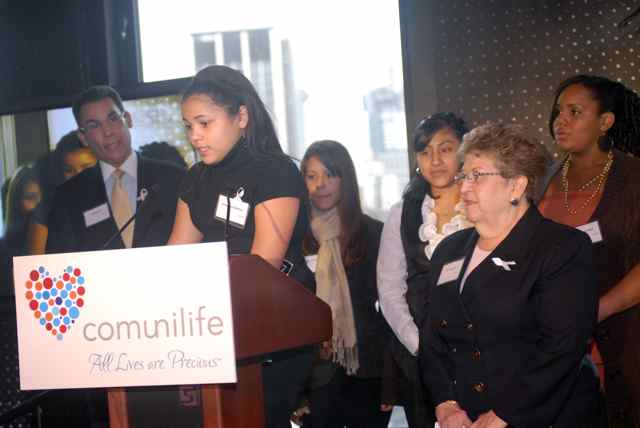 Currently 11 percent of Latinas in the country attempt suicide. In New York City, the overall rate is 15 percent. But in the Bronx and Brooklyn, Latina suicide attempts total a staggering 22 percent – double the national rate. Dr. Gil said many Latino families in these areas are in crisis, and face economic, housing and other stressors. In addition, there has been some anti-Hispanic sentiment in the Bronx and Brooklyn that seems to have added an element of fear for many families.
 Recently the Health and Human Services Office of Adolescent Health announced a funding opportunity for teen pregnancy prevention with the caveat that all funds be used to implement one of 28 specific programs. These programs, OAH noted, had undergone “rigorous evaluation” and were deemed the best of their kind in reducing teenage pregnancy and its behavioral risks. But in an NAHF review of the empirical tests used to evaluate the programs, only 18 percent of all participants were Hispanic. Further, of the 29 studies on the programs, only 15 even included Hispanic youth.
 To conduct tests that narrow the teen pregnancy program selection to 28 without including a large swath of the population is like “mandating that everyone in the country undergo a particular medical treatment that hasn’t taken into account diet, body type, activity level, and other important factors,” Zayas said. “We’re just saying these 28 youth programs may not be the best empirically tested interventions given that the studies in which they were developed and tested omitted a large portion of the population.”