NAHF Releases Report On Teen Pregnancy

While Latino teens have the highest birth rates of any youth population in the United States, they are alarmingly underrepresented in the testing of programs touted by the federal government as the best interventions geared to reduce teen pregnancies, according to a new study released today by our organization.

“We’re asking how government officials know these are the best 28 teen pregnancy programs if only 18 percent of the kids who participated in the evaluation of these programs were Latino — the group with the highest teen pregnancy rate,” said Dr. Luis Zayas, the study’s lead researcher and director of the Center for Latino Research at Washington University in St. Louis. “We’re not saying these programs don’t work. We’re just saying we’re not sure they’re the best and most effective for Latino youth.”

While NAHF applauds the overall initiative and the Administration’s efforts to ensure that funding generates the maximum results, the organization’s leaders are concerned that a disproportionately less number of Hispanic-serving organizations will be successful in their application for teen pregnancy prevention funds given the funding stream’s limitations. NAHF calls on the administration to correct oversights of the past and undertake more Hispanic-based research.

To conduct tests that narrow the teen pregnancy program selection to 28 without including a large swath of the population is like “mandating that everyone in the country undergo a particular medical treatment that hasn’t taken into account diet, body type, activity level, and other important factors,” Zayas said. “We’re just saying these 28 youth programs may not be the best empirically tested interventions given that the studies in which they were developed and tested omitted a large portion of the population.”

Click here to see the full report.
Results of Public Funding Survey

Thank you to all NAHF members and friends who completed the funding survey distributed by email several weeks ago. As promised, we are providing results of this survey which show the gap between Hispanic community organizations and public funding entities. With recent efforts by the federal government to rely on states to distribute federal funds fairly and appropriately, the survey results are of concern. While many of the respondents have received federal funds, the overwhelming majority believe the access of Hispanic-serving organizations to both federal and state financial resources is extremely limited.

Given this information, it is important that NAHF members:

a. raise the awareness of public funders to the value and services Hispanic-serving organizations provide in your community,

b. pursue opportunities to build bridges between public funders and Hispanic serving organizations, and

c. ask elected officials to ensure that proportionate levels of public funding reach Hispanic communities and those organizations who will serve them best.

Grant Funding To Hispanic-Serving Organizations

Summary of Survey Results
Overview

Urban Strategies (US), in partnership with the National Alliance for Hispanic Families (NAHF), conducted a survey to gather information on Hispanic-serving organizations’ experience with and perceptions of both state and federal government grant funding. The purpose of the survey was to understand whether Hispanic-serving organizations are aware of and accessing government grants and to gather their input on ways to increase the level of government support to Hispanic-serving organizations. Survey results are intended to inform discussions with policymakers to take place in the summer of 2010. A total of 126 individuals completed the instrument.

Respondent Demographics and Service Focus
  • Nearly 70% of respondents lived in California, Illinois, and Texas, with the remaining respondents from 19 other states.
  • 43.2% of respondents reported having a staff of 0 to 5 full-time employees. The next highest response was 100+ employees at 19.3%, implying a vast spread in the size of respondents’ organizations.
  • Similarly, approximately 48.7% of respondents reported budgets of under $500,000, and 40% of respondents reported budgets of greater than $1 million.
  • Parenting education/enhancement services are provided by approximately 6 out of 10 respondents (62.2%), as are marriage and relationship education/enhancement services (60%).
  • Teen pregnancy prevention and fatherhood services are provided by approximately 3 out of 10 respondents (29.6%).
  • Other service areas most often identified by respondents included a range of services for youth (e.g., mentoring, early childhood, education/tutoring, abuse prevention, gang prevention); services to address issues related to poverty (e.g., food pantries, workforce development/job training, housing/shelters); and services to the incarcerated.
  • 62.8% of respondents reported that 70% or more of the people they serve are Hispanic, and 81.8% reported that 51% or more are Hispanic.
  • An overwhelming majority (95.6%) believe that there is unmet need for their services in their local Hispanic community, and 68.5% cited insufficient budget as one cause.
Survey Findings and Themes: State Grants
  • More than 6 out of 10 respondents (63.1%) were unaware of state government grants available to support the services they are providing or could provide in their local Hispanic community.
  • Organization size appeared to correlate to some degree with organizations’ awareness of state grants: more than half (53.1%) of respondents answering “no” to the question about awareness of state government grants reported having 0 to 5 employees. However, small size did not guarantee that organizations are unaware of grants, as 11% of those answering “no” to this question reported more than 100 employees.
  • Similarly, nearly 6 out of 10 respondents (58.9%) who are not aware of state government grants estimated their operating budget at under $500,000. However, small budget size did not guarantee that organizations are unaware of grants, as 29.5% of those answering “no” to this question reported a budget of greater than $1 million.
  • 41 respondents reported that they had received a state grant in the past.
  • When organizations who had never applied for a state grant were asked why they had not applied, the top four reasons included not knowing about the grant (53.9%), not having a grant writer (43.8%), not knowing how to apply (29.2%), and not having enough time (25.8%).
  • When asked what would make them more likely to apply for a state grant, the most common answer was being aware of opportunities (e.g., “More information of available state resources for small organizations” and “Just need to be aware of the RFP”). The three other most common types of responses included gaining more knowledge of the process, having access to a grant writer or other person to help, and having a simpler process.
  • Although almost 6 out of 10 respondents reported knowing of a Hispanic-serving organization that had received a state grant, an overwhelming majority (86.4%) believed that an insufficient amount of money is reaching Hispanic communities to fund the types of services their organizations provides or could provide.
  • When asked what they believed would help more state grant money reach their local community to fund these types of services, the most common responses by organizations who did not know about state grants were related to increased outreach and awareness. In general, these respondents felt that:
  1. their organization needs to be more aware of the available opportunities;
  2. states need to conduct better outreach about opportunities to Hispanic-serving organizations in order for more awareness to occur; and
  3. states need to be more aware of the need among Hispanic-serving organizations.
  • The second and third most common types of responses to this question given by organizations that were generally unaware of grants included training/education and equitable allocation or set-asides for Hispanic-serving organizations/programs.
Survey Findings and Themes: Federal Grants
  • In general, respondents were more aware of federal grants available to pay for the types of services they provided, with more than 6 out of 10 (62.9%) saying they are aware of these grants.
  • Respondents were also more likely to have received federal grants then state grants, with 63 respondents saying they had won a federal grant in the past.
  • Reasons cited for not applying for federal grants did not significantly differ from those cited regarding state grants (i.e., not knowing about the grant, not having a grant writer, not knowing how to apply, and not having enough time).
  • As with state grants, most of respondents’ answers fit into four primary themes when they were asked what would make them more likely to apply: awareness/knowledge of opportunities, access to grant writing services or a grant writer, a simpler process, and more knowledge and understanding of how to do it.
  • 75.6% of organizations knew of Hispanic-serving organizations that had received a federal grant, yet more than 8 out of 10 respondents (86.2%) believed that the tax dollars reaching Hispanic-serving organizations providing the types of services they do or could provide are insufficient.
Selected Respondent Feedback and Suggestions

Respondents were given the opportunity to write in reasons they had not applied for state or federal grants in the past and what would make them more likely to apply in the future. The following list includes a selection of responses to these questions.

  • “In the past we expanded a substantial amount of operating funds in applying for grants, with little success for all of the effort. We decided that we were better off using our limited resources on the actual work with Hispanic nonprofits then to use said money on competitive grants.”
  • “Help organizations working in the Latino community to better access the state grants.”
  • “Attend a workshop that will provide all the steps.”
  • “Grant writing is full time. Running a program and trying to write the grant lessens the possible strength and effectiveness of the effort.”
  • “By building awareness of the need at the national and state levels, more funds can be made available to address service needs within the Hispanic community. Public forums can be held to build awareness.”
  • “More equitable distribution of state resources to Latino communities.”
  • “More studies on the Hispanic community that proof [sic] the needs of the services. Fare [sic] allocation of the state money.”
  • “Entrenchment – same large mainstream orgs get money – they don’t serve or cannot appropriately serve needs of Hispanic community.”
Implications of Study

The findings of this survey imply that more work needs to be done to inform policymakers and federal agency leadership about the needs and challenges facing Hispanic communities and the organizations who serve them. Policy direction could also focus on ensuring that funds to serve Hispanic communities are allocated to organizations from within the Hispanic community that have a demonstrated track record of providing culturally appropriate services. Efforts could also focus on helping smaller, less established Hispanic-serving organizations compete for grant funds.

Given respondents’ focus on becoming more aware of opportunities and on becoming more equipped to respond to them, future directions could also include examining outreach to Hispanic-serving organizations by government organizations and implementing culturally appropriate grant writing training to boost organizational capacity.

NAHF Members Invited To White House Fatherhood Event

by Lorena Gonzalez

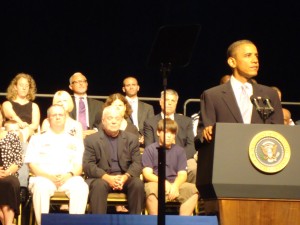
Luis Zayas, Lisa Cummins, and I, were invited to take part in the launch of President Obama’s next phase of the Fatherhood Initiative, introduced last year to engage fathers throughout the country in the lives of their children and families.

Obama’s plan includes the establishment of a Fatherhood, Marriage and Families Innovation Fund to support the best and most successful initiatives in states and communities offering services such as job training, parenting skills classes and domestic violence prevention. The plan also calls for helping dads get caught up on child support payments and finding transitional jobs for ex-offenders and low-income, non-custodial fathers. In addition, the Justice Department will create a Fathering Re-Entry Court to reach dads as they’re leaving the criminal justice system to help them find jobs, make child support payments and reconnect with their families.
A panel of individuals at the event highlighted the personal impact of their own fathers. One told of his father driving him back and forth to college classes, and the impact that quality time had on his life.

“The key message I think all of us want to send today to fathers all across the country,” President Obama said, is that “our children don’t need us to be superheroes. They don’t need us to be perfect. They do need us to be present. They need us to show up and give it our best shot, no matter what else is going on in our lives. They need us to show them — not just with words, but with deeds — that they, those kids, are always our first priority.”

Guests at the event were invited to bring their children with them to the event. Dr. Luis Zayas, NAHF Research Committee chairman, was asked to sit with his son on stage. “It was such an honor to share this moment with my son,” Zayas said.

ABOVE PHOTOS: Dr. Luis Zayas pictured on back row with his son during President Obama’s fatherhood speech. President Obama interacts with fathers and sons.

White House Conference Call Update

Hispanic community leaders joined White House staff this week for the first conference call of the Obama Administration focusing on issues specifically relevant to the Hispanic community.

Joshua DuBois, the Director of the White House Office for Neighborhood Partnerships, and Stephanie Valencia, the White House Associate Director in the Office of Public Engagement, discussed the importance of the Hispanic community, and asked for our input and engagement in the Administration’s activities.

With the upcoming celebration of Father’s Day, Mr. DuBois talked about the Administration’s efforts to provide opportunities and supports for fathers and families. He invited Hispanic leaders to join the effort to support fatherhood initiatives in our communities.

Following the White House presentation, conference call participants were invited to share comments and questions. The common theme among these comments focused on, 1) the need to increase funding for existing father, marriage, and family programs, and, 2) the importance of incorporating family components into fatherhood initiatives.

Some 80 organizations affiliated with the National Alliance for Hispanic Families participated in the call. We look forward to keeping our network informed of similar opportunities as we continue to help Hispanic families reach their greatest potential.

NAHF Celebrates First Year Success

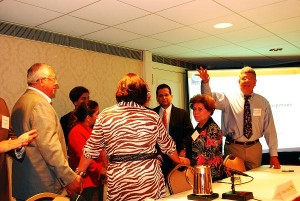
Just one year ago this month, NAHF launched its effort to strengthen Hispanic families during a Washington, DC summit attended by individuals representing government, academic and community interests from across the country. During the summit, national leaders including Henry Cisneros and Congressman Raul Grijalva challenged NAHF to harness public and private resources to address issues facing Latinos. One year later, we are 300 members strong and growing daily.
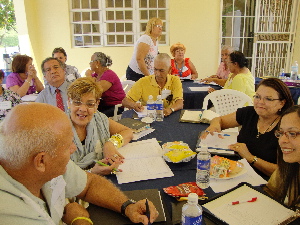
Our accomplishments over the past year are many. Through town hall meetings in San Antonio, Houston, New York, Miami, Puerto Rico, Chicago, and Las Vegas, we learned of the needs and dreams of your communities. These meetings brought together elected officials, community, business, and faith-based leaders, as well as parents and students.

In many areas, small groups were formed from these town hall meetings to move forward the NAHF agenda. In Puerto Rico, for example, a group of 40 individuals gathered to talk about challenges within the Latino community there. This group set priorities and mapped out an approach to address these issues and recently applied for a federal teen pregnancy grant.

We now communicate with thousands of interested readers through this new website and blog, and our short video on families has been shown at several conferences across the country. Leaders of NAHF spoke at the Latino Leaders Summit at the University of Texas in Austin, and have been invited to participate in White House and administration discussions about Hispanics and their needs and growing role in this country. This week NAHF researchers participated in the 13th annual Welfare Research and Evaluation Conference sponsored by the Administration for Children and Families to improve the effectiveness of the programs it sponsors.

And along with all this work, NAHF was recently awarded a Kellogg Racial Healing Grant aimed at promoting racial equity, and the group’s director, Dr. Lorena Gonzalez, received the prestigious Angel Award from the Red Dress Society for her work with NAHF and the Latino community.

Overall, our first year has been a success. We thank you for your support and constant feedback, and look forward to the next twelve months of even greater achievement in helping Hispanic families reach their potential. We invite you to join the Alliance and become part of this exciting work.

ABOVE PHOTOS: Joe Hernandez, Family Wellness Associates, leads an interactive discussion on families at the NAHF Summit, held June 2, 2009 in Washington, DC. Small group meeting in Puerto Rico to develop strategy for strengthening Hispanic families.

NAHF Leaders in Washington

NAHF executive committee members Dr. Luis Zayas and Dr. Lorena Gonzalez met with Carmen Nazario, Assistant Secretary for Children and Families in Washington recently. Nazario conducted a forum to engage Hispanic leaders from around the country in discussing ways to better connect with the Hispanic community, improve programs, and develop strategies to eliminate barriers to access ACF programs. Dr. Zayas emphasized the importance of the three pillars of NAHF, which include conducting relevant research, implementing programs that work through the family, and developing public policies that put families first.

Other NAHF members who attended the event included Jerry Tello, Fatherhood leader, Mercedes P. DeColon, AVANCE, Maria Elena Girone, president of Puerto Rican Family Institute, Elba Montalva of the Committee for Hispanic Children and Families, and Alicia Diaz of the Cuban American National Council, Inc.

In addition to the forum, NAHF members met with leaders from the White House and the Department of Health and Human Services to encourage the pursuit of policies that serve Hispanic communities through the lens of families.

Pictured above: Jerry Tello, Lisa Cummins, Luiis Zayas, and Lorena Gonzalez in Washington

NAHF Background Information

The Hispanic population has become the largest and fastest growing minority community, accounting for half of the country’s population growth since 2000.1 The purchasing power of more than 40 million Hispanic U.S. residents reached $870 billion in 2008.2 The annual growth rate of Hispanics in the workforce has been four to eight times greater than that of non-Hispanics for nearly a decade.2 And, in last year’s presidential election, the increasing influence of the Hispanic population was evident as three out of four Hispanics voted for President Obama in key battleground states including California, Florida, Colorado, New Mexico, and Nevada.

This exponential growth has not been without challenges. Approximately 28% of Latino children live in poor families. Rates of child poverty among Latino children range from 20% in New Jersey, Florida, and Illinois to 35% in Texas.4 Hispanic youth are 3 times more overrepresented in the high school drop out rate. The out of wedlock birth rate among Hispanics remains high while research shows that Latino children of single mothers are more than twice as likely to be poor as those in two-parent families.5 Finally, despite comprising nearly 15% of the country’s population, Hispanics are under-represented in policy-making, administrative, and elected office positions. For example, only 5% of Congressional seats are held by Hispanics.

In spite of the growing and unmet needs set against the backdrop of a rapidly growing population, the greatest asset among the Hispanic community remains the family. Regrettably, strategies and initiatives aimed at supporting the Hispanic community have focused on individual needs outside the context of the family, resulting in outcomes that fall short of achieving long-term, sustainable impact. Families are the “system” in which individuals, especially Hispanics, thrive or fail. Research shows that strong families provide an environment in which children and youth flourish, and where individuals can learn the skills that will enable them to effectively function in today’s challenging environment.

Recognizing a vacuum of comprehensive strategies that strengthen Hispanic families, national and local leaders have joined together to form the National Alliance for Hispanic Families. To achieve the goal of ensuring that families are the foundation to any social initiative, the Alliance will engage in three key areas: Program Intervention and Prevention facilitates increased resources to comprehensively serve Hispanic children and families, at the core of which is family relationship development through problem solving skills, communication skills, conflict management, and shared family values; Public Policy that educates policy makers on family relationship development strategies within the Hispanic community; and Research highlights the unique strengths and needs within the Hispanic family.

Collectively, the founding members of the National Alliance for Hispanic families represent a politically and geographically diverse collection of organizations committed to strengthening the Hispanic family.

1Research and Markets report, released May 19, 2008
2U.S. Census Bureau
3Pew Hispanic Center, The Hispanic Vote in 2008
4National Center for Children in Poverty
5Fact Sheet on Latino Youth: Poverty and Income, University of California – San Francisco

Press Release

Group Launches Bold Hispanic Initiative

Washington, DC (March 11, 2009) – A coalition of Hispanic leaders today launched the National Alliance for Hispanic Families, a bold and innovative initiative aimed at harnessing public and private resources to strengthen Hispanic families throughout the United States.

The new organization plans to promote comprehensive program services, relevant research, and strategic public policy decisions that promote and strengthen Hispanic families. Leaders of the Alliance believe that current social service programs often focus too narrowly on individuals alone, rather than within the context of their families. The group’s goal is to create a long-term strategy that works with and through families and provides an environment in which children and youth flourish.


The Alliance’s efforts are consistent with themes President Barack Obama plans to address, including responsible fatherhood, enhancing the role of parents in the family and reducing teenage pregnancy. Tuesday Obama told members of the U.S. Hispanic Chamber of Commerce the high-school drop-out rate among Latinos is unacceptable and called for individuals from all backgrounds to come together to solve this “epidemic.”

For Hispanics, the drop-out rate is one of several challenges. Studies show that in 2007, nearly 30 percent of all Hispanic children lived in poverty, and an increasing number of babies were born out of wedlock to Hispanic teenage mothers.

“We want to bring the issues facing Hispanic families to the forefront while promoting comprehensive social service strategies that leverage the community’s greatest asset – the family,” says Dr. Blanca Enriquez, a leader in Head Start programming and member of the NAHF executive committee.

The framework of the Alliance was formed during a meeting last November where leaders from across the country discussed the need for a national plan to expand the work of the Hispanic Healthy Marriage Initiative currently funded by the department of Health and Human Services. Members of the group’s executive steering committee include Frank Fuentes, HHS; Dr. Blanca Enriquez, El Paso Head Start; Jose Villalobos, TELACU; Dr. Alicia La Hoz, Chicago Family Bridges Project; and Lisa Treviño Cummins of Urban Strategies.

“As the fastest growing segment of the U.S. population, our country’s prosperity is intricately linked to the Hispanic community ,” said TELACU’s Villalobos. “And success within the Hispanic community is directly tied to the strength of their families.”

In June, the organization’s founders will host a national leaders forum in Washington, D.C. to further develop the Alliance’s long-term strategy to build on the Hispanic communities’ assets to serve families in need.