We at NAHF wish all mothers a Happy Mother’s Day this weekend. Mothers play a vital role in the family, and we honor the countless hours they spend nurturing, teaching, and supporting.
 As we celebrate Mothers and the entire Hispanic family, NAHF leaders continue to be a resource to policymakers on issues affecting families and the Hispanic community.
Hispanic Research Work Group Meeting
Several members of NAHF participated this week in the Administration for Children and Families’ (ACF) Hispanic Research Work Group Meeting in Washington, DC (Dr. Blanca Enriquez, Dr. Alicia La Hoz, Dr. Luis Torres-Hostos, and Dr. Luis Zayas). Participation in the meeting was part of the ongoing efforts of NAHF to promote research that addresses the social and economic experiences of low-income Hispanics in the U.S. while incorporating Hispanic culture and relevance.
Dr. Luis Torres-Hostos, assistant professor at the University of Houston’s Graduate College of Social Work, presented research commissioned by NAHF on the deficiencies of evidence-based programs. He said these programs generally lead to improved outcomes, but requiring all programs to incorporate only interventions proven effective from an empirical review as a condition for funding may shortchange Hispanics and other communities of color. These communities are frequently under-represented in research studies that seek to find evidence of an intervention’s success, he said
Alliance members have participated in previous ACF research meetings, and will continue to act as a resource to the group while presenting ideas and suggestions on how its research efforts can be used to engage and serve the Hispanic community.
YOU’RE NEXT Workshops
Three grant-writing workshops sponsored by ACF and co-hosted by NAHF and other local groups have been praised by participants in San Antonio, Los Angeles, and Chicago.
“Of all the grant-writing seminars I have attended thus far, this was the best one, especially because you took the time to share great techniques on how to win a federal grant for our organization and program(s),” one participant wrote.
Among other things, the two-day workshops focus on collaborating with multiple organizations to write a grant, writing SMART objectives, and developing competitive budgets. Two final workshops are scheduled for Miami this weekend, and New York City, June 6-7. (Details and registration on left column.)
White House Agenda and the Hispanic Community
NAHF has tirelessly worked to educate and raise awareness within the Obama Administration of the challenges and opportunities in serving the Hispanic community. We are pleased to report that this week, President Obama released his plan for engaging the Hispanic community in a document entitled Winning the Future: President Obama’s Agenda And The Hispanic Community. In the 34-page document, Obama outlines issues he plans to address which are of vital importance to the Latino community, including immigration reform, improved educational opportunities for Hispanic children and improving the lives of Latino workers and their families.
The White House also launched a new website targeting Hispanics: www.whitehouse.gov/hispanic. A copy of the President’s Agenda for Hispanics can be downloaded from the site.
Image credit: http://earlyrecovery.wordpress.com
 In late fall, a delegation of NAHF members met with George Sheldon, Acting Assistant Secretary of the Administration for Children and Families (ACF), to discuss the agency’s limited service to the Hispanic community. In follow-up dialogue, Mr. Sheldon requested suggestions for improving the agency’s work with Hispanics. The following eight recommendations were made by NAHF:
 We, as leaders of NAHF, were inspired last week as we watched more than 150 individuals in Puerto Rico receive certificates after completing an extensive course on family strengthening.
 For years our family, like many of yours, has carried out traditions that honor our past and create a foundation for the future. Our Hispanic heritage is rich with holiday celebrations that strengthen our ties with family and friends.
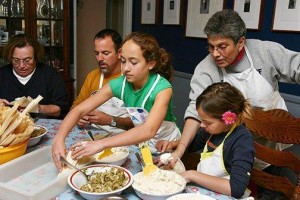 The posada is often followed by a children’s party, and of course the highlight is the breaking of a pinata brimming with treats and small gifts.
 Recently I received a letter from a woman who participated in an event co-sponsored by NAHF and Family Service Association. She attended our two-and-a-half-day training session in San Antonio and then applied for a Compassion Capital Fund grant to purchase computers for a high school diploma project she helps oversee. From her letter, she says:
 Given that teen pregnancy is at a crisis level among Latinas, the National Alliance for Hispanic Families has been proactive in its pursuit of educating decision makers about the need for funding to serve Hispanic teens. We have engaged our leaders from across the country, arranging meetings and presentations with White House officials and congressional offices. We’ve supported outreach of the OAH and other interested national organizations. Finally, we have addressed the concern that there are too few Latino-focused grant applications by working hand-in-hand with community orgnizations throughout the country to help them submit proposals for this round of OAH grants. When the grant awards were announced, we found very little evidence of our efforts: only two of 158 grantees are Hispanic focused organizations with a demonstrated history of serving Hispanic communities.
 Recientemente, La Oficina para la Salud Adolescente de los Servicios Humanos y de Salud anunció una oportunidad para financiar la prevención de embarazos en la adolescencia con la salvedad de que todos los fondos fuesen usados para implementar uno de los 28 programas específicos. Estos programas, el OAH acotó, han sufrido una “rigurosa evaluación” y fueron determinados como los mejores en su clase para la reducción de embarazos adolescentes y sus riesgos de la conducta. Pero en una revisión del NAHF sobre estas pruebas empíricas usadas para evaluar los programa, solo el 18 por ciento de todos los participantes fueron hispanos. Más aún, de los 29 estudios sobre los programas, solo 15 apenas incluyeron a la juventud hispana.